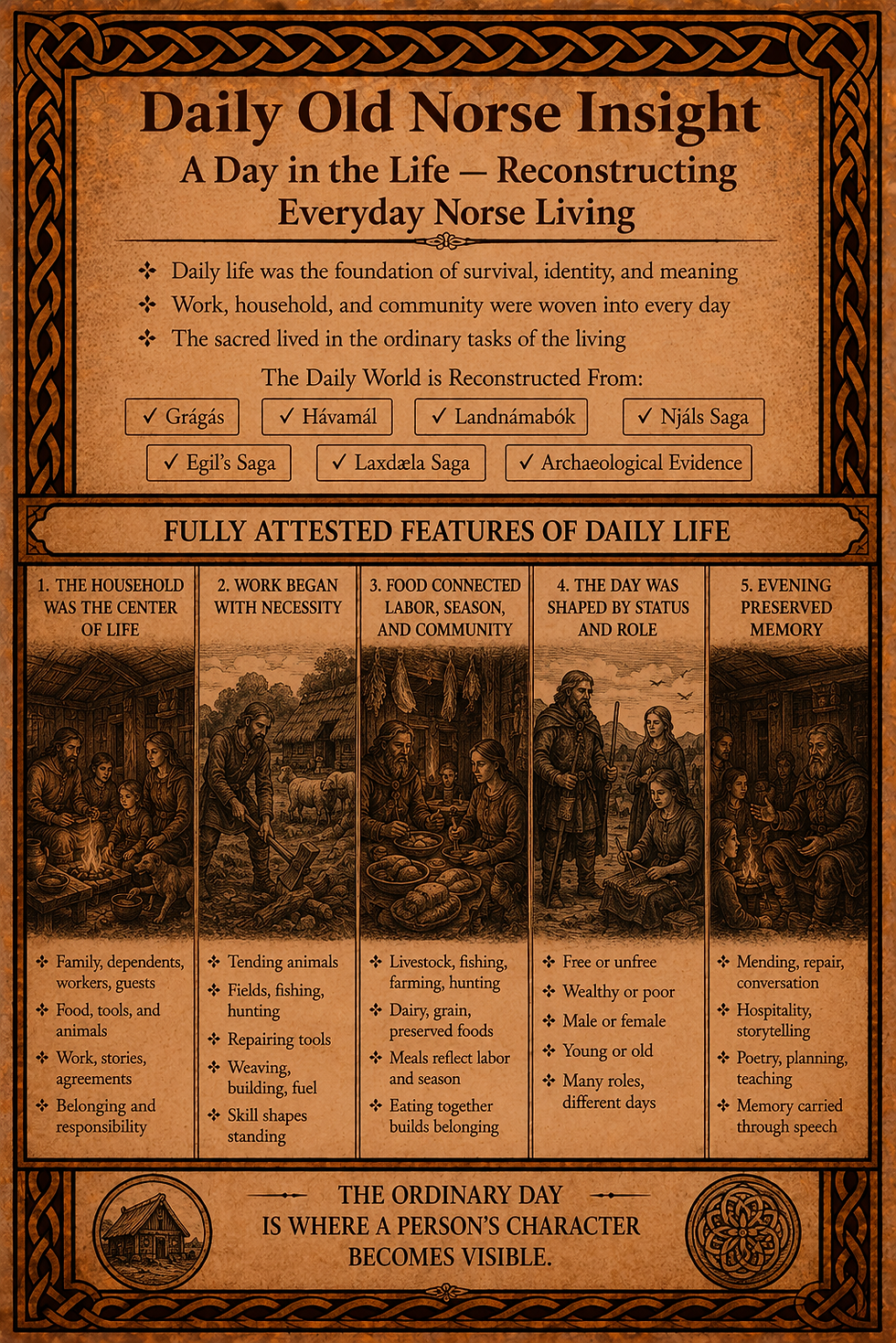
Daily Old Norse Insight - A Day in the Life – Reconstructing Everyday Norse Living

Most people in the Old Norse world were not raiders, kings, or saga heroes. They were farmers, fishers, craftworkers, household managers, children, elders, servants, and kin.
Daily life was shaped by work, weather, animals, food, law, family, and the turning of the seasons. The sacred was not separate from this. It lived in the hearth, the field, the tools, the doorway, the meal, and the obligations that held the household together.
The daily world is reconstructed from:
· Grágás
· Hávamál
· Landnámabók
· Njáls Saga
· Egil's Saga
· Laxdæla Saga
· Archaeological evidence of farms, longhouses, tools, textiles, food remains, workshops, and burial goods
Across these, a consistent pattern emerges,
daily life was not simple or empty,
it was the place where survival, identity, and meaning were made real.
Fully Attested Features of Daily Life
1. The Household Was the Center of Life
The farmstead was one of the basic units of society.
A household could include:
· family members
· dependents
· workers
· guests
· animals
· stored food and tools
The household was not only where people slept.
It was where food was prepared, children were raised, agreements were made, stories were told, and the work of survival was organized.
To belong to a household was to belong to a living structure of responsibility.
2. Work Began With Necessity
Daily work depended on season, region, wealth, and role.
Common tasks included:
· tending animals
· preparing food
· repairing tools
· gathering fuel
· fishing or hunting
· working fields
· weaving and textile work
· maintaining buildings and fences
Work was not separate from identity.
A person's usefulness, reliability, and skill helped determine their standing among others.
3. Food Connected Labor, Season, and Community
Food was not taken for granted.
It came from:
· livestock
· fishing
· farming
· hunting
· dairy work
· stored grain
· preserved foods
Meals reflected the labor of the household and the success of the season.
To eat together was not only practical.
It reinforced belonging.
The shared meal reminded people that survival depended on many hands.
4. The Day Was Shaped by Status and Role
Old Norse society was not equal in the modern sense.
Daily life looked different depending on whether someone was:
· free or unfree
· wealthy or poor
· male or female
· young or old
· household head, dependent, guest, or servant
This matters.
There was no single universal Norse experience.
But across these differences, everyone lived within structures of duty, expectation, and social consequence.
5. Evening Preserved Memory
When the day's work was done, the household remained a place of culture.
Evenings could involve:
· mending
· tool repair
· conversation
· hospitality
· storytelling
· poetry
· planning for the next day
This is where memory lived.
Names, deeds, family history, warnings, wisdom, and humor were carried forward by speech.
A day ended, but what was spoken could remain.
Interpretive Layer
A reconstructed “day in the life” is not directly given to us as one complete account in the sources.
Instead, we build it from many kinds of evidence:
· saga scenes
· law codes
· archaeology
· tools and buildings
· food remains
· burial goods
· settlement patterns
This means we must be careful.
There was no single Norse day.
A farmer in Iceland, a trader in Birka, a fisher on the coast, and a household worker in Denmark may have lived very different daily lives.
But the pattern is clear:
Life was practical, relational, seasonal, and deeply rooted in the household.
Modern Relevance
A day in the Old Norse world reminds us that meaning is not only found in great events.
It is found in ordinary responsibility.
The old sources ask us to look again at the daily tasks we often overlook:
· feeding others
· keeping promises
· maintaining a home
· repairing what is broken
· teaching children
· preparing for what comes next
These are not small things.
They are the foundation of community.
In the Old Norse worldview, a life was not built only in battle, ritual, or great moments of fame.
It was built every day.
At the hearth.
In the field.
At the workbench.
Around the table.
Among the people who depended on you.
The ordinary day was where a person's character became visible.


Comments