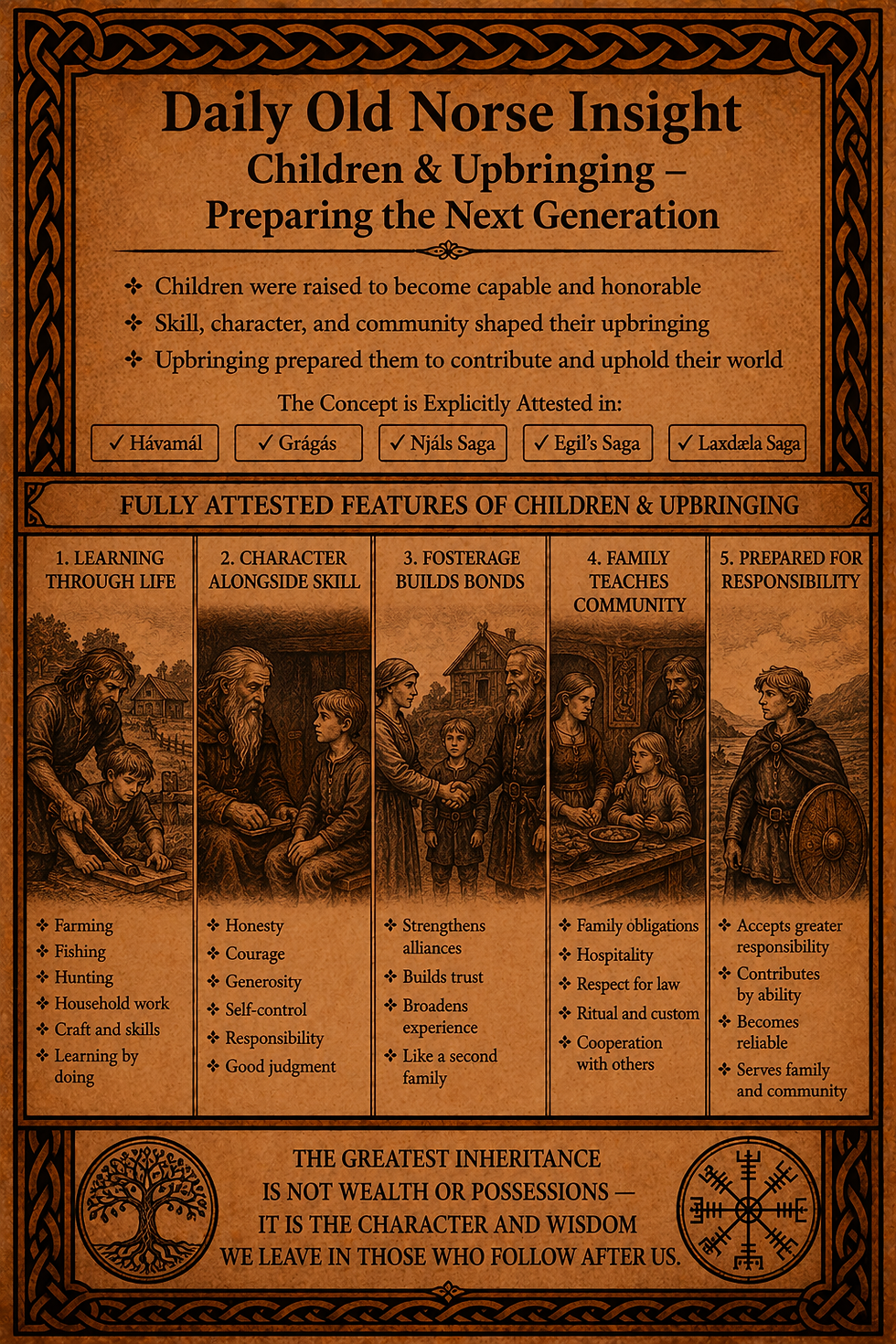
Daily Old Norse Insight - Children & Upbringing – Preparing the Next Generation
- dustinstorms
- Jul 2
- 3 min read

In the Old Norse world, childhood was not viewed as a separate stage of life disconnected from adulthood. From an early age, children were gradually introduced to the responsibilities, skills, and values that would allow them to contribute to their family and community.
Parents, extended family, and foster families all played important roles in this process. A child's upbringing was not simply about survival, it was about preparing them to live honorably and capably within society.
The concept is explicitly attested in:
· Hávamál
· Grágás
· Njáls Saga
· Egil's Saga
· Laxdæla Saga
Across these, a consistent pattern emerges,
children were not expected to remain dependent,
but to grow steadily into capable members of their community.
Fully Attested Features of Children & Upbringing
1. Learning Began Through Daily Life
Children learned by participating.
From an early age they observed and gradually took part in:
· farming
· fishing
· hunting
· household work
· textile production
· craftwork
Knowledge was passed through experience as much as instruction.
Life itself became the classroom.
2. Character Was Taught Alongside Skill
The sources place great value on personal conduct.
Children were expected to learn:
· honesty
· courage
· generosity
· self-control
· responsibility
Practical ability mattered, but so did the development of good judgment and reliable character.
3. Fosterage Strengthened Families and Alliances
One of the most distinctive features of Old Norse society was fosterage.
Children, particularly among prominent families, might be raised for a time by another household.
Fosterage helped to:
· strengthen alliances
· build trust between families
· broaden a child's experience
A foster relationship was often regarded as nearly as significant as a blood relationship.
4. Family Was the First Community
Parents were responsible not only for providing food and shelter, but for introducing children to the customs and expectations of society.
Within the household, children learned:
· family obligations
· hospitality
· respect for law
· participation in ritual
· cooperation with others
The home was where community began.
5. Children Were Prepared for Adult Responsibility
Growing older meant gradually accepting greater responsibility.
As children matured, they were expected to contribute according to their abilities.
The goal was not independence for its own sake.
The goal was becoming someone others could rely upon.
Capability was one of the greatest gifts an adult could give a child.
Interpretive Layer
The medieval sources do not present a formal philosophy of childhood.
Instead, they reveal an educational approach through stories, laws, and everyday life.
Learning was deeply integrated into the community.
Rather than separating education from life, the Old Norse world largely treated life itself as the means through which knowledge, values, and identity were passed from one generation to the next.
Modern Relevance
The Old Norse approach to raising children asks a timeless question:
What kind of adult are we preparing them to become?
Knowledge is important.
But so are:
· resilience
· kindness
· responsibility
· curiosity
· the willingness to contribute
Children learn far more from what they see than from what they are told.
The Old Norse sources remind us that every shared meal, every skill taught, every story told, and every example set becomes part of the next generation.
For in the end,
the greatest inheritance is not wealth or possessions.
It is the character and wisdom we leave in those who follow after us.


Comments