Daily Old Norse Insight - Fólkvangr – Freyja’s Hall and Its Ambiguity
- dustinstorms
- Apr 14
- 2 min read

In Old Norse tradition, Fólkvangr is the realm associated with the goddess Freyja, where she receives a portion of the slain. It is one of the clearest reminders that the afterlife in Norse cosmology is not singular, simple, or fully explained.
Much about Fólkvangr is stated plainly,
and yet, much is left unanswered.
The concept is explicitly attested in:
Grímnismál
Gylfaginning
These sources confirm its existence, but offer very little detail, leaving space for interpretation.
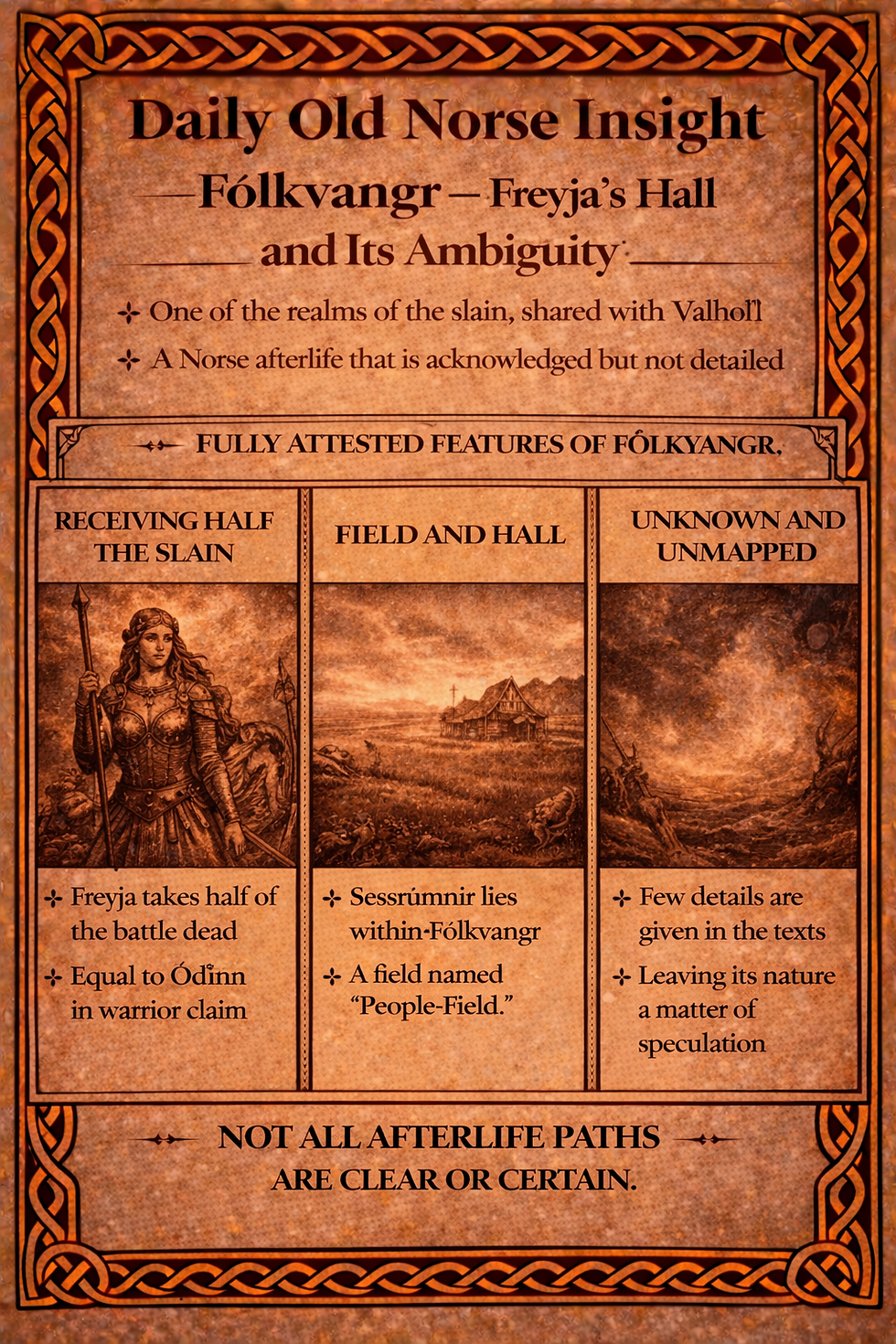
Fully Attested Features of Fólkvangr
1. Freyja Receives Half the Slain
The most direct statement comes from Grímnismál:
Freyja chooses half of those who die in battle, while Óðinn receives the other half in Valhǫll.
This reveals:
Valhǫll is not the sole destination of warriors
Freyja holds equal claim over the battle-slain
selection, not just death, determines the afterlife
Fólkvangr is therefore not secondary, it is parallel.
2. The Field and the Hall
Fólkvangr means “Field of the People” or “Field of the Host.”
Within it lies Sessrúmnir, Freyja’s hall, mentioned in Gylfaginning.
This suggests a structure of:
an open realm or field
a central hall within that space
Unlike Valhǫll, which is richly described, Fólkvangr remains quiet in the sources.
Its nature is implied, not detailed.
3. A Realm Without Description
One of the most striking aspects of Fólkvangr is how little is said.
There are no clear accounts of:
daily activity
feasting or fighting cycles
conditions of existence within it
This silence matters.
It suggests that:
not all realms were equally mythologized
some aspects of belief were less fixed in narrative
the afterlife was not fully systematized
Fólkvangr stands as a known unknown.
4. Freyja’s Role and Nature
Freyja is associated with:
love and desire
fertility and life
death and the slain
seiðr and hidden knowledge
Her receiving the dead reflects a broader truth:
death is not separate from life,
it is part of the same cycle.
Those who enter Fólkvangr pass into the care of a figure who embodies both creation and ending.
5. The Ambiguity of the Afterlife
Fólkvangr highlights something essential:
the Old Norse afterlife is not a single, unified system.
Instead, it includes:
Valhǫll
Fólkvangr
Hel
other possible destinations hinted in saga and tradition
There is no single path for all.
Fate, circumstance, and selection shape the journey.
Modern Relevance
Fólkvangr reminds us that not everything was explained,
and not everything needs to be.
It shows that:
mystery is part of belief
not all truths are fully spoken
the unseen world is not always mapped in detail
In a culture rich with story, Fólkvangr remains quiet.
And in that quiet, it invites reflection.
For sometimes what is not described tells us as much as what is.
It leaves us with a simple truth:
Not all who fall go to one hall.
And not all paths beyond death are meant to be clearly known.


Comments