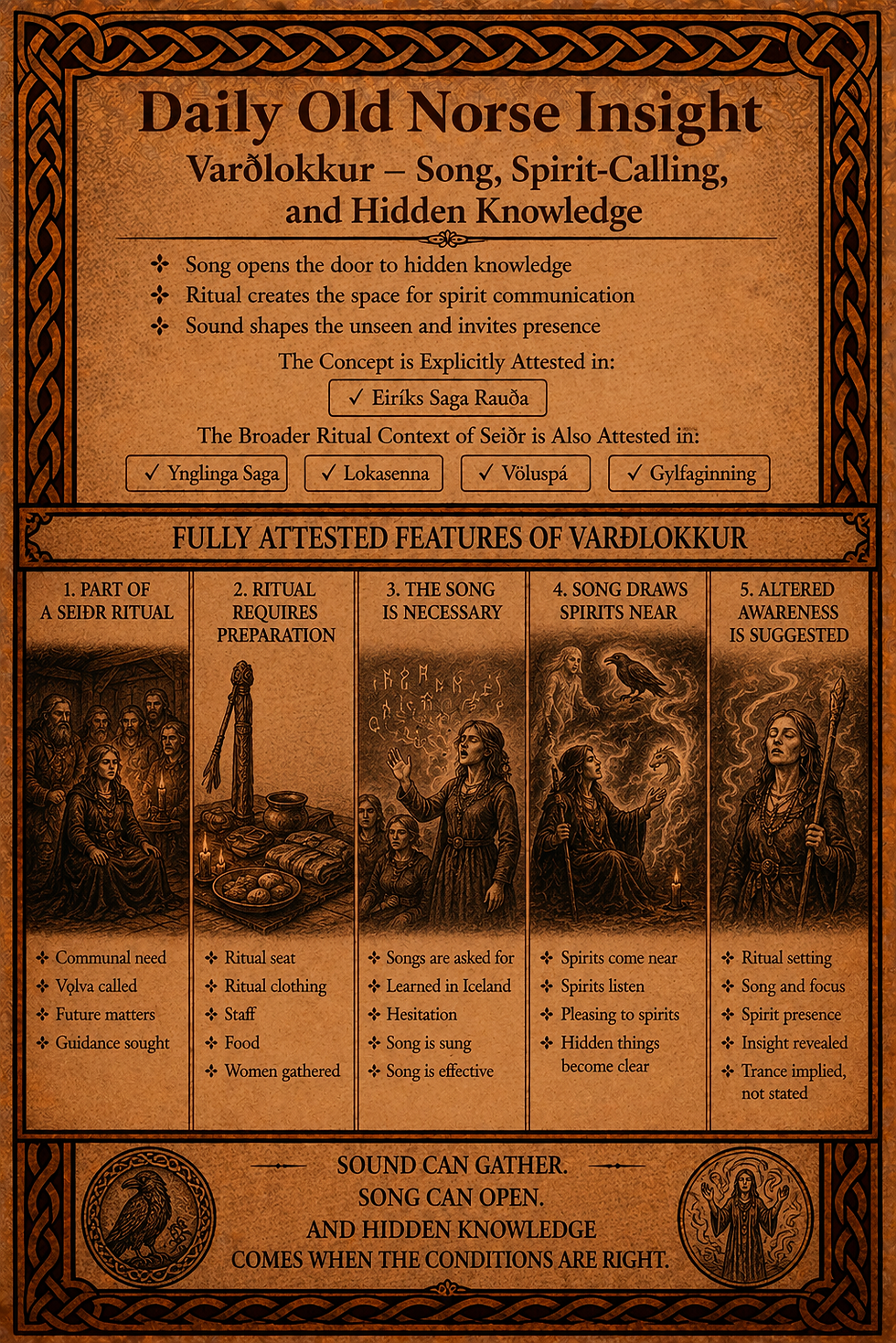
Daily Old Norse Insight - Varðlokkur – Song, Spirit-Calling, and Hidden Knowledge

Varðlokkur is one of the most fascinating ritual terms preserved in the Old Norse sources.
It appears in connection with seiðr, prophecy, and the work of the vǫlva. The word is often understood as a kind of spirit-calling song, though its exact meaning is debated. What matters most is how it functions in the source: the song helps create the conditions for hidden knowledge to become accessible.
The concept is explicitly attested in:
· Eiríks Saga Rauða
The broader ritual context of seiðr is also attested in:
· Ynglinga Saga
· Lokasenna
· Völuspá
· Gylfaginning
Across these, a consistent pattern emerges,
ritual knowledge is not reached through words alone,
but through song, setting, altered attention, and relationship with unseen powers.
Fully Attested Features of Varðlokkur
1. Varðlokkur Appears in a Seiðr Ritual
The clearest account appears in Eiríks Saga Rauða.
During a time of hardship in Greenland, the vǫlva Þorbjǫrg lítilvǫlva is invited to a household to reveal what will happen.
This shows that the rite was not random or private.
It was performed in response to communal need.
The people sought guidance because the future mattered to everyone.
2. The Ritual Required Preparation
Before the prophecy is given, the household prepares carefully.
The account describes:
· a special seat or platform
· ritual clothing
· a staff
· particular food
· women gathered around the seeress
· the performance of the song
This suggests that seiðr was not casual magic.
It was structured, formal, and carried out with deliberate attention.
3. The Song Was Necessary for the Rite
Þorbjǫrg asks for women who know the required songs.
At first, no one comes forward.
Then Guðríðr says she learned the songs in Iceland, though she is hesitant to take part because she is Christian.
When she finally sings, the song is described as beautiful and effective.
This shows that varðlokkur was not decoration.
It was part of the working itself.
4. The Song Draws Spirits Near
After Guðríðr sings, Þorbjǫrg says that many spirits came near and were pleased to listen.
She also says that things which had previously been hidden are now clear to her.
This is the key point.
The song appears to help open communication with unseen beings or powers.
It creates the condition in which prophecy becomes possible.
5. Trance Is Suggested Carefully, Not Stated Directly
Modern readers often describe seiðr as trance work.
That may be a useful comparison, but the source itself does not give us a detailed psychological description.
What the account does show is:
· ritual setting
· song
· elevated seating
· spirit presence
· hidden knowledge becoming visible
So it is safer to say that varðlokkur belongs to a ritual process that may involve altered awareness, rather than claiming the source gives us a full trance technique.
Interpretive Layer
The meaning of varðlokkur is debated.
It is often interpreted as:
· spirit-calling songs
· songs that attract guardian powers
· chants that summon or invite unseen beings
This fits the scene in Eiríks Saga Rauða, where the spirits are said to come near after the song is performed.
But we should be careful.
The sources do not preserve the words of the song.
They do not give us a manual for how it was sung.
They do not explain the full theory behind the practice.
What they do preserve is enough to show that voice, sound, and ritual performance played a real role in accessing hidden knowledge.
Modern Relevance
Varðlokkur reminds us that speech and song can change the state of a space.
A song can gather people.
A chant can focus attention.
A spoken word can mark a boundary between ordinary life and ritual action.
The Old Norse sources suggest that sound was not merely expressive.
It could be active.
It could call.
It could open.
It could invite presence.
The question becomes:
· What do your words call toward you?
· What kind of space does your voice create?
· And are you careful with the powers you invite in?
In the Old Norse worldview, ritual is not only something believed.
It is something performed.
And varðlokkur shows that sometimes the path to hidden knowledge begins not with sight,
but with song.


Comments