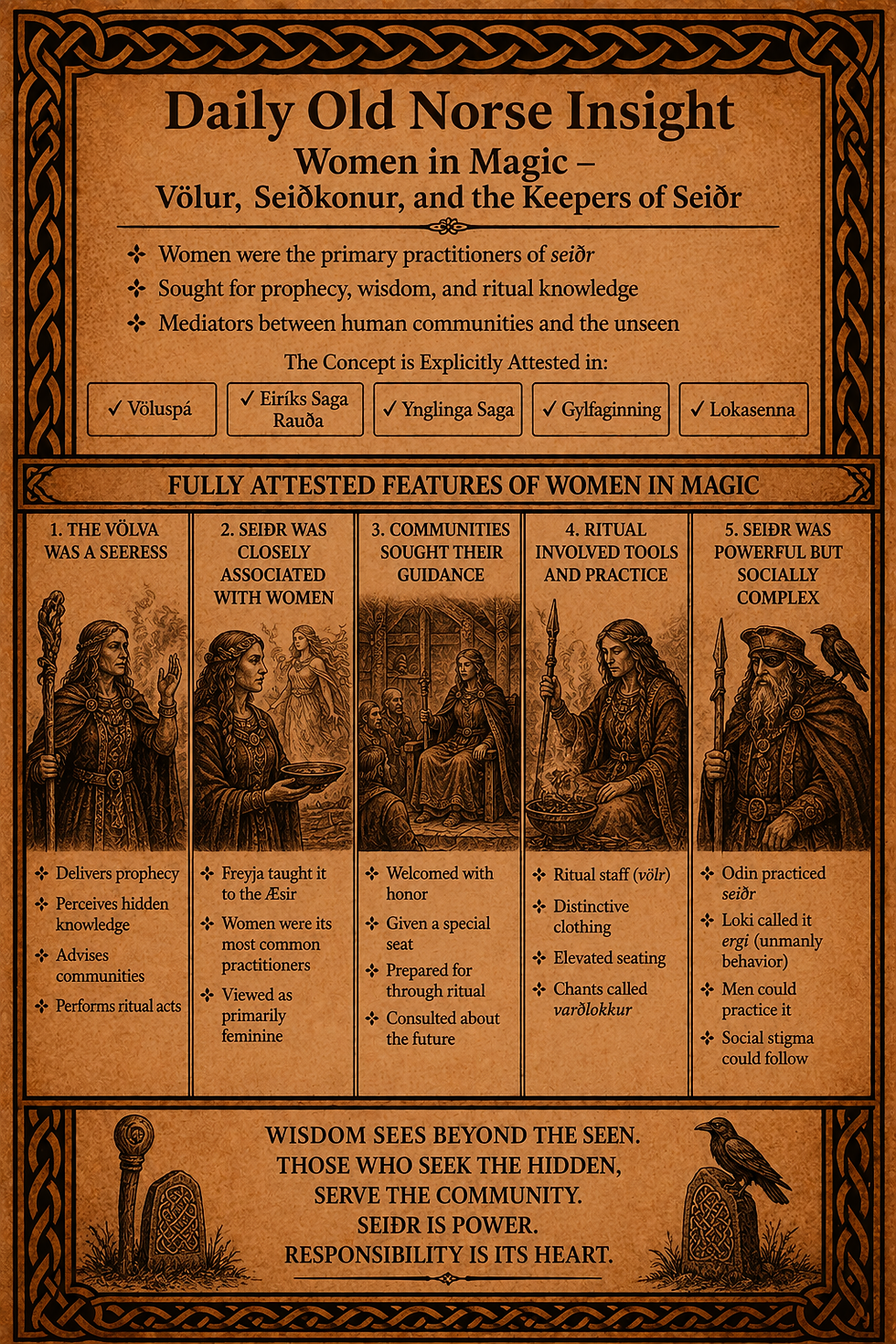
Daily Old Norse Insight - Women in Magic – Völur, Seiðkonur, and the Keepers of Seiðr

In the Old Norse sources, women are the figures most closely associated with the practice of seiðr. They appear not as mythical caricatures, but as respected, and sometimes feared, individuals whose knowledge reached beyond the ordinary.
Whether called a völva or a seiðkona, these women occupied a unique place within society. They were sought for prophecy, wisdom, and ritual practice, standing at the meeting point of the seen and the unseen.
The concept is explicitly attested in:
· Völuspá
· Eiríks Saga Rauða
· Ynglinga Saga
· Gylfaginning
· Lokasenna
Across these, a consistent pattern emerges,
women are presented as the primary practitioners of seiðr,
serving as mediators between human communities and hidden knowledge.
Fully Attested Features of Women in Magic
1. The Völva Was a Seeress
The word völva means "staff-bearer," referring to the ritual staff she carried.
The sources describe her as one who could:
· deliver prophecy
· perceive hidden knowledge
· advise communities
· perform ritual acts
Her authority came not through political office, but through specialized knowledge.
2. Seiðr Was Closely Associated with Women
In Ynglinga Saga, Snorri states that Freyja taught seiðr to the Æsir.
Throughout the surviving sources, women appear as its most common practitioners.
This association is so strong that the practice came to be viewed as primarily feminine within Old Norse society.
3. Communities Sought Their Guidance
One of the clearest accounts appears in Eiríks Saga Rauða.
There, a völva is invited to a settlement suffering hardship.
She is:
· welcomed with honor
· provided a special seat
· prepared for through ritual
· consulted about the future
This shows that her role was communal rather than secretive.
She was invited because her knowledge was valued.
4. Ritual Involved Specialized Tools and Practice
The sources associate female practitioners with ritual objects and carefully structured ceremonies.
These include:
· the ritual staff (völr)
· distinctive clothing
· elevated seating
· chants known as varðlokkur
The details suggest that seiðr was not improvised magic, but a recognized ritual tradition.
5. Seiðr Was Powerful but Socially Complex
Although women were closely associated with seiðr, the sources also describe Oðinn practicing it.
In Lokasenna, Loki accuses Oðinn of performing seiðr, calling it ergi, a term expressing behavior considered socially unmanly.
This tells us two important things:
· men could practice seiðr
· doing so could carry social stigma
The issue was not the power of seiðr, but how society viewed those who practiced it.
Interpretive Layer
The surviving sources do not present the völur as isolated witches or solitary magicians.
Instead, they appear as ritual specialists who served important social and religious functions.
Modern portrayals often emphasize mystery and secrecy, but the medieval texts more often show them working openly within their communities, offering guidance during times of uncertainty.
Modern Relevance
The völur remind us that wisdom often takes forms beyond physical strength or political authority.
Their influence rested upon:
· knowledge
· experience
· careful observation
· the trust of their communities
The question becomes:
· What kind of wisdom do people seek from you?
· How do you cultivate knowledge worthy of trust?
· And do you use what you know for your own gain, or for the benefit of others?
In the Old Norse worldview, true authority did not always come from a throne or a sword.
Sometimes it came from the one who could see further than everyone else, and who carried that responsibility with care.


Comments