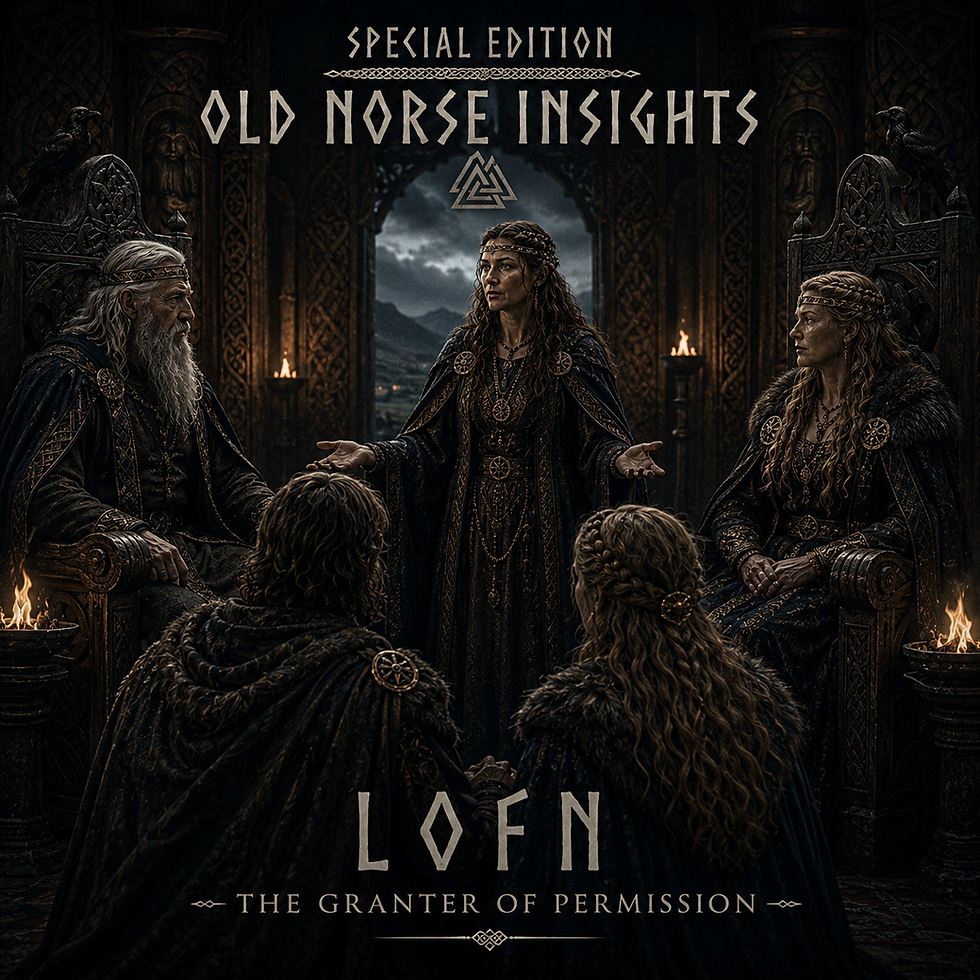
Special Edition Old Norse Insight - Lofn – The Granter of Permission
- dustinstorms
- Jun 28
- 2 min read

Lofn is one of the lesser-known ásynjur named in the sources.
She receives only a brief description, yet that description reveals a unique role among the goddesses.
Where others are associated with wisdom, battle, or fate, Lofn is connected with permission, reconciliation, and the removal of obstacles between people.
What Is Actually Attested
• Lofn is listed among the ásynjur in Gylfaginning
• She is described as being so gentle and kind that she obtains permission from the All-Father or Frigg for unions between a man and a woman, even when such unions had previously been forbidden or refused
• Because of her name, permission is said to be called lof in the source
That is the full description preserved in the medieval text.
No myths center on her.
No genealogy is provided.
No individual deeds are recorded beyond this role.
Yet her purpose is clearly stated.
Her Name, A Glimpse of Meaning
The name Lofn is closely connected in the source with:
• Lof – permission, leave, approval, praise (depending on context)
The exact linguistic relationship is debated, but the medieval explanation emphasizes permission or consent.
Whether preserving an older tradition or offering a learned interpretation, the connection is explicit in the text.
Reading the Pattern (From What Is There)
The description of Lofn is remarkably restrained.
She does not ignore custom.
She does not overturn law.
She does not encourage rebellion.
Instead, she obtains permission.
This is an important distinction.
The Old Norse world was structured by families, kinship, alliances, and obligations.
Marriage was rarely only a matter of personal affection.
It carried legal, social, and economic consequences.
Lofn's role is therefore not one of breaking order, but of finding a lawful path through it.
She represents reconciliation rather than defiance.
The Deeper Pattern
The Old Norse sources often portray order as something that must be maintained, yet they also recognize that circumstances change.
Feuds can end.
Settlements can be reached.
Old barriers can be removed.
Lofn reflects this quieter side of order.
She reminds us that strength is not always found in holding firm.
Sometimes it is found in allowing a new path to open.
Permission is not weakness.
It is the deliberate choice to make peace where division once stood.
A Note on Marriage and Permission
It is easy to read Lofn as simply a goddess of romance.
The surviving description, however, points to something broader.
Her role concerns relationships that had been forbidden or denied, and the obtaining of approval for them.
The source does not describe secret unions or the rejection of social order.
Instead, it presents Lofn as one who helps make legitimate what had previously been withheld.
The emphasis is not on passion alone.
It is on permission, agreement, and resolution.
Closing Reflection
Lofn does not force hearts together.
She does not command love.
She does not sweep obstacles aside through power.
She asks.
She persuades.
She opens a way where none seemed possible.
And perhaps that is her quiet lesson.
For not every barrier is meant to be broken.
Some are meant to be crossed only when wisdom, patience, and permission walk together.


Comments