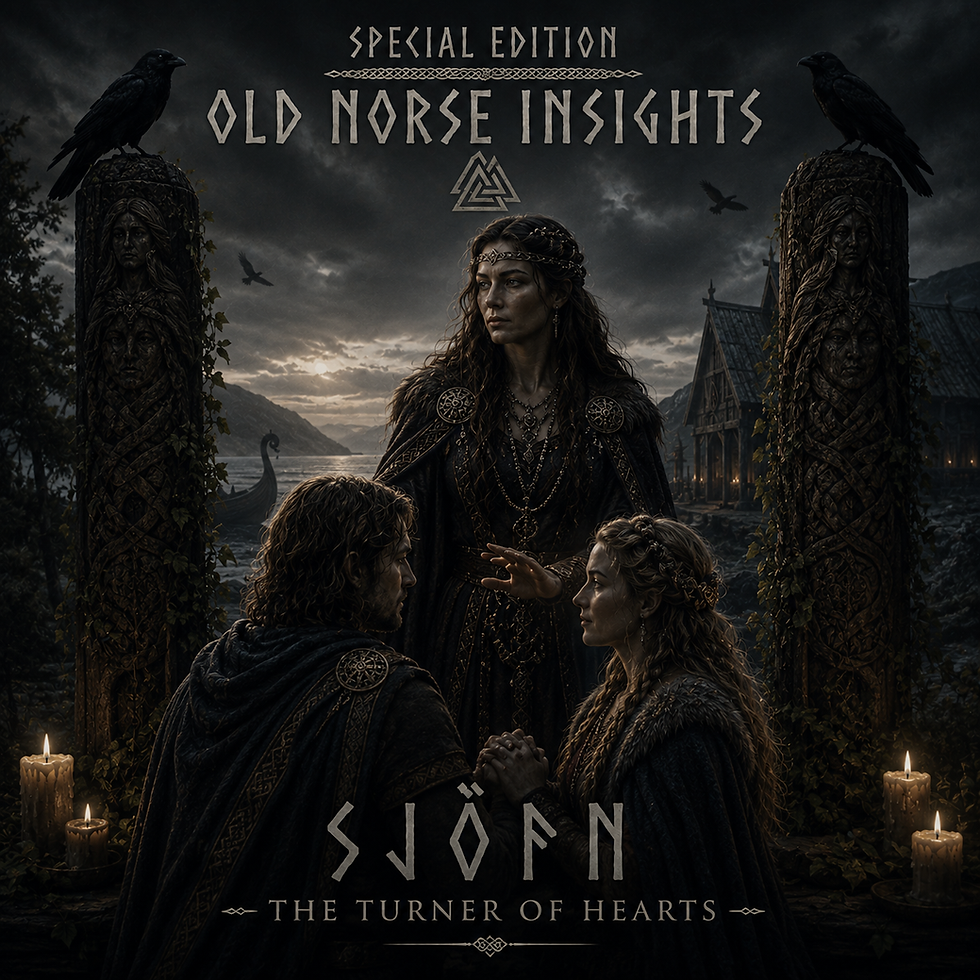
Special Edition Old Norse Insight - Sjǫfn – The Turner of Hearts

Sjöfn is one of the lesser-known ásynjur named in the sources.
Only a single short description survives, yet it reveals a role unlike that of any other goddess.
Rather than ruling over war, fertility, or wisdom, Sjǫfn is connected with the movement of human affection itself.
What Is Actually Attested
• Sjǫfn is listed among the ásynjur in Gylfaginning
• She is said to direct the minds of people toward love, both women and men
• Because of her name, affection or love is said to be called sjafni
That is all the surviving description tells us.
No myths place her at the center of a story.
No genealogy is given.
No deeds beyond this role are recorded.
Yet her function is clearly stated.
Her Name, A Glimpse of Meaning
The exact origin of the name Sjöfn is uncertain, but medieval tradition explicitly connects it with:
• Sjafni – affection, love, or deep attachment
Whether this reflects an older linguistic relationship or an explanation offered by later writers remains debated.
What is clear is the association preserved in the sources:
Sjöfn is linked with the awakening of affection between people.
Reading the Pattern (From What Is There)
The wording of the source is striking.
Sjöfn does not command love.
She does not force it.
She does not choose who is worthy.
She directs people's minds toward affection.
This is a subtle distinction.
Love, in the Old Norse world, is not portrayed here as something imposed from outside.
Instead, the heart is turned.
Attention is drawn.
The possibility of affection is awakened.
The source speaks of both women and men alike, suggesting that her influence is not limited to one sex or one social role.
The Deeper Pattern
Throughout the Old Norse world, relationships formed the foundation of society.
Marriage created alliances.
Friendship established loyalty.
Fosterage forged families beyond blood.
Gift-giving strengthened bonds.
Communities endured because people chose to invest themselves in one another.
Sjöfn reflects the beginning of that process.
Before there is an oath,
before there is a marriage,
before there is kinship by choice,
there is the turning of one heart toward another.
Not every relationship becomes lasting.
Not every affection becomes a vow.
But every enduring bond begins with someone first seeing another differently than they did before.
A Note on Love in the Sources
It is easy to imagine Sjöfn as a goddess of romance alone, but the surviving text is more restrained than that.
The Old Norse word translated as "love" or "affection" can encompass esteem, fondness, attachment, and deep regard, not only romantic desire.
The sources do not limit her influence to passion.
They simply tell us that she inclines minds toward affection.
Closing Reflection
Sjöfn carries no famous weapon.
She utters no great prophecy.
She stands behind no legendary battle.
She simply turns one heart toward another.
And perhaps that is enough.
For before trust can grow,
before promises can be spoken,
before families and friendships can be formed,
someone must first choose to care.
And Sjǫfn is remembered as the one who gently turns the heart in that direction.


Comments